|
⚡ Quick Answer (TL;DR) Ofgem has confirmed the October–December 2026 dual-fuel Direct Debit cap at £1,723/yr (up 4% / £60 from £1,663 in July–September). Electricity: 26.32p/kWh + 54.83p/day (0% VAT 1 Oct 2026–30 Jun 2027). Gas: 7.97p/kWh + 29.68p/day (5% VAT). TDCV is 2,500 kWh electricity / 9,500 kWh gas. Households on a standard variable tariff (SVT) with a mainstream supplier pay at or near that ceiling. Specialist green-gas suppliers have historically charged a premium above it. We do not invent live supplier pound prices on this page — get a written quote at your kWh, then compare it to the official October pence. |
Updated September 2026. This legacy guide now matches Ofgem's confirmed October–December 2026 cap (published 26 August 2026). For current deals, read Cheapest energy deals UK — October 2026 and Dual fuel energy deals UK — October 2026. Ofgem's next announcement is 25 November 2026 for January–March 2027.
Knowing which energy supplier is charging you the most — and why — is still one of the most useful pieces of consumer knowledge in 2026. Whether you are asking “who is the most expensive energy provider UK?”, “is British Gas the most expensive?”, or simply looking for a better deal, this guide gives you the Ofgem-anchored answer without pretending a spring ranking table is still live.
What's in This Guide
• Section 1: How “most expensive” actually works in 2026
• Section 2: Who tends to cost the most — green premium vs SVT vs a competitive fix
• Section 3: Why some energy providers charge more than others
• Section 4: Energy prices by region — where standing charges bite
• Section 5: How much could you save? Compare against the £1,723 illustration
• Section 6: How to choose a supplier without relying on stale named deals
• Section 7: How to switch away from an expensive supplier — step by step
• Section 8: Frequently Asked Questions
How “Most Expensive” Works Under the October Cap
Image: supplier ranking context for 2026 | switchsquid.com
The most expensive energy supplier UK in any given month depends on your tariff type, not the brand on the bill. Customers on Standard Variable Tariffs (SVTs) with mainstream suppliers — including British Gas, EDF Energy, ScottishPower, and OVO Energy — sit at or close to the Ofgem price-cap ceiling. From 1 October 2026 that ceiling is the confirmed typical dual-fuel Direct Debit figure of £1,723/year at TDCV 2,500 kWh electricity / 9,500 kWh gas.
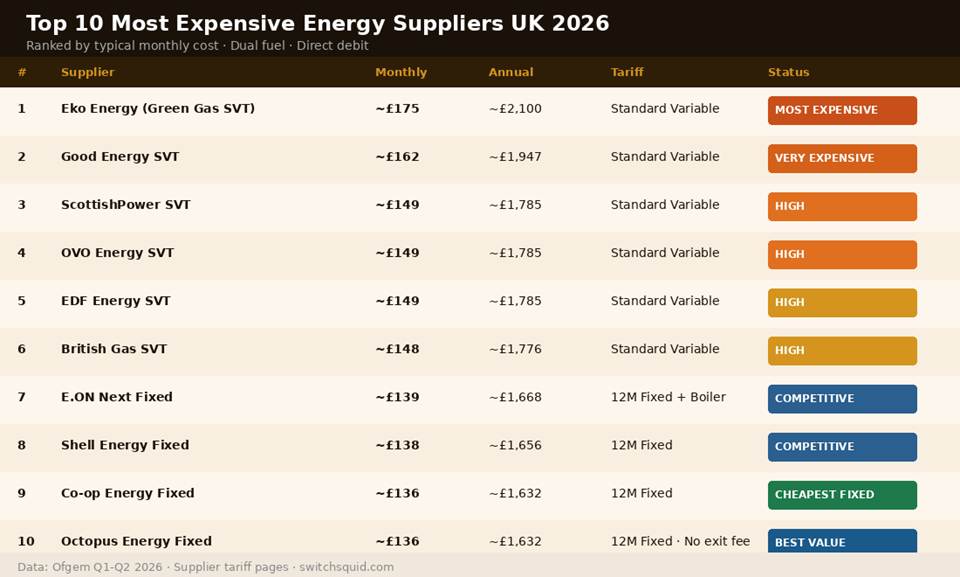
Specialist green suppliers such as Eko Energy and Good Energy have historically charged more than that SVT ceiling because 100% green gas (biomethane) costs more to source. That ranking pattern is still the right mental model; the pound amounts on older tables are not.
What this page will not do
We will not republish a live “top 10” with invented monthly or annual £ prices. Spring 2026 copy on this URL ranked SVTs around £1,776–£1,785 against a Q2 cap of £1,641, and named Octopus / Co-op 12-month fixes at about £1,632 as “already below the cap”. Those were a March 2026 snapshot. Treat them as history. Confirm any supplier’s annual total on a tariff information label at your actual kWh.
Cost ladder (qualitative — check a live quote)
|
Rung |
Who it usually is |
Why it costs more or less |
How to check it now |
|
1. Green-gas premium |
Specialist 100% green-gas SVTs (historically Eko Energy, Good Energy) |
Biomethane / organic-waste gas is genuinely more expensive than the SVT cap formula |
Ask for the annual total at your kWh. Do not assume the old ~£2,100/yr figure still applies |
|
2. SVT at the cap |
British Gas, EDF, ScottishPower, OVO and most default dual-fuel SVTs |
The cap is a ceiling on unit rate and standing charge. SVT customers pay that ceiling |
Illustration: £1,723/yr typical dual-fuel Direct Debit (Oct–Dec 2026) |
|
3. Competitive fixed deal |
Digital-first and challenger 12-month fixes (historically Octopus, Co-op and others) |
A written fix can beat the SVT illustration after standing charges and exit fees |
Compare on Cheapest energy deals UK — October 2026 then get a quote |
|
⚠️ Tariff type matters more than supplier brand The single biggest driver of whether you are paying the most or least for energy in 2026 is whether you are on a Standard Variable Tariff or a proactively chosen fixed deal — not which supplier you are with. A British Gas 12-month fix can be cheaper than an Octopus Energy SVT. Always compare the annual total at your usage. |
Visual: why the brand on the bill is the wrong ranking
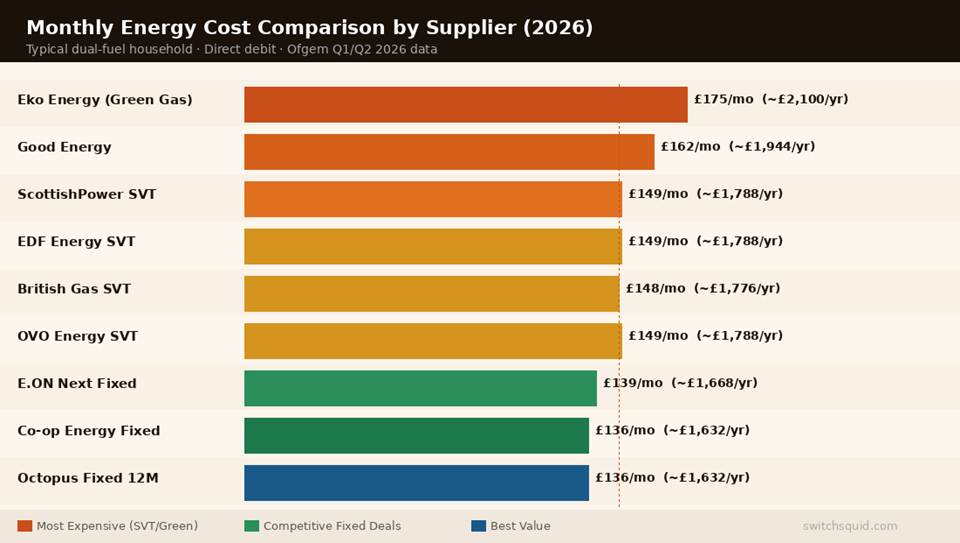
Image: monthly energy cost comparison chart — UK suppliers 2026 | switchsquid.com
Who Is the Most Expensive Gas and Electricity Supplier?
Who is the most expensive gas and electricity supplier in the UK depends on whether you combine dual fuel or look at each fuel separately — and on whether you are on an SVT or a fix.
Most expensive electricity supplier UK (SVT framing)
On a Standard Variable Tariff, mainstream suppliers charge at the Ofgem electricity ceiling. For October–December 2026 that national Direct Debit average is 26.32p/kWh + 54.83p/day (0% VAT from 1 October 2026 to 30 June 2027). Specialist green tariffs have historically sat above that unit rate. We do not quote a live “highest p/kWh” for a named supplier here.
Most expensive gas supplier UK
For gas, specialist 100% green-gas suppliers have unambiguously been the most expensive — biomethane injection costs more than conventional natural gas. For the large mainstream suppliers, SVT gas sits at the cap: 7.97p/kWh + 29.68p/day (5% VAT) as the national Direct Debit average for October–December 2026.
Most expensive dual-fuel supplier
ScottishPower, EDF, and British Gas SVTs are effectively tied at the cap for dual-fuel Direct Debit customers — the typical illustration is £1,723/year, not the old Q1 ~£1,785 figure. A competitive 12-month fix can undercut that illustration; confirm it in writing. Do not use the retired ~£1,632 Octopus / Co-op headline as a current price.
The SVT trap: standard variable vs fixed tariff
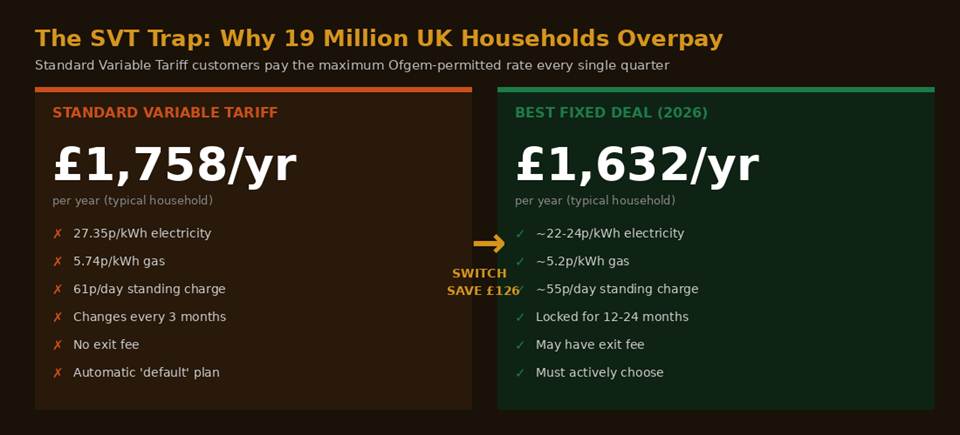
Image: SVT vs fixed tariff cost comparison explainer | switchsquid.com
Key insight: Ofgem still estimates that around 65% of households are not on a fix. Those households pay the maximum permitted unit rate and standing charge every quarter. A written 12-month fix is worth it if its annual total at your actual kWh beats the October SVT illustration after exit fees. See Fixed vs variable — winter 2026 for the decision tree.
Why Are Some Energy Providers More Expensive?
The price difference between suppliers is not arbitrary. Five structural factors still drive higher bills in 2026.
1. Wholesale energy procurement strategy
~40% of your energy bill is wholesale cost — what your supplier paid to buy gas and electricity in advance. Hedging strategy differs by supplier. That is why two SVTs can sit at the same cap while two fixes diverge.
2. Green gas and renewable premium
Suppliers offering 100% green gas — biomethane, anaerobic digestion, or organic waste — pay a genuine premium above conventional gas. Eko Energy (formerly Green Energy UK) and Good Energy pass that cost on, which is why they have ranked as the most expensive energy suppliers in absolute terms, for verifiable environmental reasons.
3. Network distribution charges (DNO costs)
Suppliers pay Distribution Network Operators to transport energy to homes — and these charges vary by region. North Wales, Merseyside, and parts of Scotland have among the highest distribution costs. They are passed through and typically make up 20–25% of a bill. Regional unit rates and standing charges therefore differ even on the same tariff name.
4. Operating overheads: legacy vs digital-first
Legacy suppliers like British Gas, EDF, and ScottishPower still carry large operational footprints. Digital-first challengers use technology to lower cost-to-serve. That gap is one reason “is British Gas the most expensive?” is such a frequent search — on an SVT, British Gas is at the cap with the other large suppliers; on a fix, it may not be.
5. Exit fees and tariff lock-in
Some fixed-rate deals still carry exit fees of £30–£75 per fuel (up to £150 dual fuel). A cheap-looking unit rate is not a saving if the exit fee wipes it out. SVTs have no exit fees by Ofgem rules, which is why staying on the SVT can be rational if no written fix beats the £1,723 illustration after fees.
|
Key terms SVT / Standard Variable Tariff: Default tariff when a deal ends — tracks the Ofgem cap. Usually the most expensive ongoing option among conventional tariffs. Ofgem Price Cap: The quarterly ceiling on the unit rate and standing charge SVT customers can be charged. Not a cap on your total bill. Unit Rate: Pence per kWh — the per-unit cost of the gas and electricity you consume. Standing Charge: A fixed daily charge regardless of usage. October–December 2026 national Direct Debit averages are 54.83p/day electricity and 29.68p/day gas. TDCV: Typical Domestic Consumption Values. The £1,723 headline uses 2,500 kWh electricity and 9,500 kWh gas, not the old 2,700 / 11,500 presentation. REGO Certificates: Renewable Energy Guarantees of Origin — proof that electricity supplied is matched to a certified renewable source. |
Energy Prices by UK Region — Where You Pay the Most
Even on the same tariff with the same supplier, where you live affects the bill. Ofgem permits suppliers to vary unit rates and standing charges by distribution region.
Qualitative pattern (not a live regional tariff table): North Wales & Mersey and North Scotland consistently show some of the highest standing charges. Yorkshire and the East Midlands are often among the lower-cost regions. London can combine a higher electricity unit rate with a lower standing charge — so a low-usage flat and a large house in the same city can rank deals differently.
We are not republishing the old regional pence table (those gas figures sat around 5.4–6.1p/kWh under an earlier cap). Ofgem publishes current regional tables. Always use a postcode-specific comparison — Switch's energy comparison — before switching.
|
Key takeaway: National averages (£1,723, 26.32p, 7.97p) are illustrations. Households in higher-cost DNO regions pay more than that typical figure at the same usage. Pull your last 12 months of kWh and run a local quote. |
How Much Could You Save by Switching?
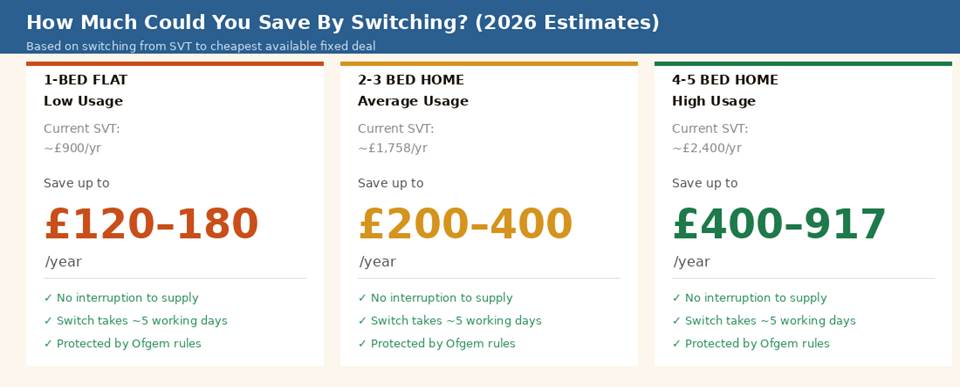
Image: energy switching savings context | switchsquid.com
The gap between an SVT at the cap and a competitive fix is real, but it is not a single national £ number we can invent. Use this hurdle instead:
Worked example at the national Direct Debit averages and TDCV (illustration, not your bill): electricity 2,500 × 26.32p = £658.00 plus 365 × 54.83p = £200.13 (~£858); gas 9,500 × 7.97p = £757.15 plus 365 × 29.68p = £108.33 (~£865); together ~£1,723.
Ofgem’s 26 August 2026 commentary said some fixed tariffs were available at £100 or more below the October cap for some customers. That is the regulator’s market comment, not a SwitchSquid live quote. Use it as a hurdle, then verify the annual total on a supplier tariff information label.
April 2026 cap drop — historical, not “act now”
From 1 April 2026 the typical dual-fuel Direct Debit cap was £1,641/year (down from £1,758 in Q1 on the figures this page used at the time). That quarter has already happened. July–September 2026 then landed at £1,663. October–December is confirmed at £1,723. Do not treat an April 2026 “act now” heading as current advice.
Fixed rate vs SVT: the decision framework (September 2026)
• Fix if: a written quote at your actual kWh beats the October SVT illustration after standing charges and exit fees — especially if you want certainty through winter.
• Stay variable if: no fix beats that illustration after fees, you use solar + battery / an EV time-of-use tariff, or you want to wait for the 25 November 2026 print (January–March 2027).
• Do not: use the retired March 2026 “£1,632 already beats the Q2 cap” line. That comparison is out of date.
Best Energy Supplier to Switch To in 2026
If you are currently with a supplier that feels expensive, the question is who to switch to. We will not crown a live “cheapest at £X/month” winner on this page. Dated October companions do the deal-by-deal work:
• Cheapest energy deals UK — October 2026
• Dual fuel energy deals UK — October 2026
• Fixed vs variable — winter 2026
Best for price (how to choose, not a live £)
Octopus Energy has consistently ranked well on price and customer service, and historically offered 12-month fixes with no exit fees. That is a pattern, not a current pound price. Get a quote, then compare the annual total to £1,723 at TDCV — or, better, to an SVT illustration built from your actual kWh at 26.32p / 7.97p plus standing charges.
Best for green energy: Good Energy or Ecotricity
If 100% genuine renewable electricity and green gas matter, Good Energy (REGO-certified) and Ecotricity remain the usual specialist options. Expect to pay a premium versus the cheapest mainstream fix — historically around 10–15%, but confirm on a live quote.
Best for customer service: check Ofgem and Citizens Advice, then the quote
E.ON Next has often scored well among large suppliers for complaints handling. Cross-check Ofgem supplier performance and Citizens Advice supplier ratings rather than a stale monthly £ column.
Best for smart tariffs: Octopus Agile / Go
Octopus Energy’s smart tariffs — Agile Octopus and Octopus Go — still suit EV owners and flexible smart-meter households. Savings depend on when you use power, not on a dual-fuel TDCV headline.
|
Compare energy deals now Use Switch's comparison tool to see ranked total costs for your postcode: switchsquid.com/compare-home-energy |
How to Switch Away From an Expensive Supplier
Switching is fully protected under UK law. Under the Energy Switch Guarantee the process typically takes around 5 working days, supply is never interrupted, and Ofgem protects your credit balance if a supplier fails. Steps:
1. Gather your current bill details. Annual kWh for gas and electricity, current unit rates, and standing charges.
2. Compare using an accredited tool. Use Switch or another Ofgem-accredited comparison with your postcode and usage. Compare dual-fuel and separate tariffs — sometimes buying gas and electricity from different suppliers is cheaper.
3. Check exit fees. On a fixed deal you can usually switch fee-free within 49 days of the end date. On an SVT there are no exit fees.
4. Accept the new tariff. Your new supplier handles the transfer. You do not need to contact the old one.
5. Take a meter reading on switch day. Submit it to both suppliers so the final bill is accurate.
6. Set a renewal reminder. Fixed deals expire. Alert yourself 49 days before the end date so you do not default back onto an expensive SVT.
|
Related Switch guides → Fixed vs Variable Energy Tariff Guide — winter 2026 decision tree against the £1,723 cap → Cheapest kWh Electricity UK — how to compare unit rates against 26.32p/kWh → Dual Fuel Energy Tariffs UK — one bill, two fuels, same October rates → Cheapest energy deals UK — October 2026 — dated companion for current fixes → Dual fuel energy deals UK — October 2026 — official £1,723 maths |
Frequently Asked Questions
Who is the most expensive energy supplier in the UK?
For mainstream suppliers on Standard Variable Tariffs, ScottishPower, EDF Energy, British Gas and OVO sit at or near the Ofgem ceiling. For October–December 2026 that typical dual-fuel Direct Debit illustration is £1,723/year. Specialist green-gas suppliers have historically been more expensive than that ceiling. We do not invent a live £/month ranking on this page.
Is British Gas the most expensive energy supplier?
On an SVT, British Gas is one of the more expensive mainstream options because it charges at the cap — alongside EDF and ScottishPower, not uniquely above them. Green specialists have typically charged more still. British Gas fixed deals can be more competitive than its SVT. The answer depends on the tariff, not the brand.
Who is the most expensive gas and electricity supplier in the UK?
For 100% green gas and electricity combined, specialist suppliers such as Eko Energy have historically been the most expensive. For conventional dual fuel on an SVT, the large suppliers are clustered at the cap (£1,723 typical Direct Debit in Oct–Dec 2026). Confirm any named tariff on a live quote.
What is a Standard Variable Tariff and why is it so expensive?
An SVT is the default tariff when a fixed deal expires or when you move in. It tracks the Ofgem price cap and moves every quarter. Because the cap is the maximum a supplier can charge on that product, SVT customers pay the ceiling unit rate and standing charge. A fix can undercut that — but only if the annual total at your kWh beats the illustration after exit fees.
Will energy prices fall in 2026?
The April 2026 cap of £1,641 is historical. July–September was £1,663. October–December is confirmed at £1,723 (published 26 August 2026). The January–March 2027 cap is not yet set — Ofgem announces it on 25 November 2026. Do not wait for a May 2026 announcement; that window has passed.
Which is the best energy supplier to switch to in 2026?
Pick the written annual total that beats the October SVT illustration at your usage, with exit fees you can live with. Octopus has often led on price and service; E.ON Next among larger suppliers for complaints handling; Good Energy and Ecotricity for verified green credentials. For live September 2026 deal lists, use the Nest companions linked above rather than this page’s retired spring table.
Can I switch suppliers if I'm in debt to my current supplier?
Yes, in most cases. If you have owed money for fewer than 28 days on a credit meter, switching is normally permitted. Prepayment customers can usually switch with debts under £500. Larger debts may need a repayment plan first — contact your supplier.
What is the cheapest energy supplier in the UK?
We do not invent a live cheapest £ price here. Compare a written dual-fuel or electricity-only quote to the October SVT illustration (26.32p/kWh + 54.83p/day electricity; 7.97p/kWh + 29.68p/day gas). Then read Cheapest energy deals UK — October 2026.